
China Top 10 Skin Esthetician Equipment Manufacturers?
China has become a significant source of professional skincare and beauty equipment. Its manufacturers produce hydrodermabrasion machines, LED systems, skin analyzers, RF devices, and multifunction facial platforms. However, choosing a reliable supplier requires more than comparing product prices.
This article examines ten leading Chinese manufacturers serving clinics, spas, distributors, and every skin esthetician seeking dependable equipment. The evaluation considers manufacturing experience, product range, quality systems, safety documentation, training, customization, warranty support, and international service. Public company information and available certifications will guide the selection. Independent verification remains essential. A polished website proves very little.
Lydia Sarfati, a respected esthetician and skincare educator, reminds professionals: “Healthy skin is beautiful skin.” That principle should influence every equipment decision. A powerful device is not automatically a better device. Treatment settings, operator training, client suitability, and maintenance can affect results more than impressive specifications. Small details matter, such as clear handpiece labels, stable cooling, replaceable tips, and responsive technical support.
The manufacturers discussed here may serve different business needs. One may excel at OEM production, while another offers stronger education or faster after-sales assistance. Some provide broad product catalogs, but their documentation may feel incomplete. That weakness deserves attention. No ranking is perfect, especially when factory performance can change over time. Buyers should request current certificates, test reports, product demonstrations, and written warranty terms before purchasing. This introduction prepares readers to compare China’s top ten manufacturers with practical judgment, professional caution, and realistic expectations.
What Defines a Leading Chinese Skin Esthetician Equipment Manufacturer?
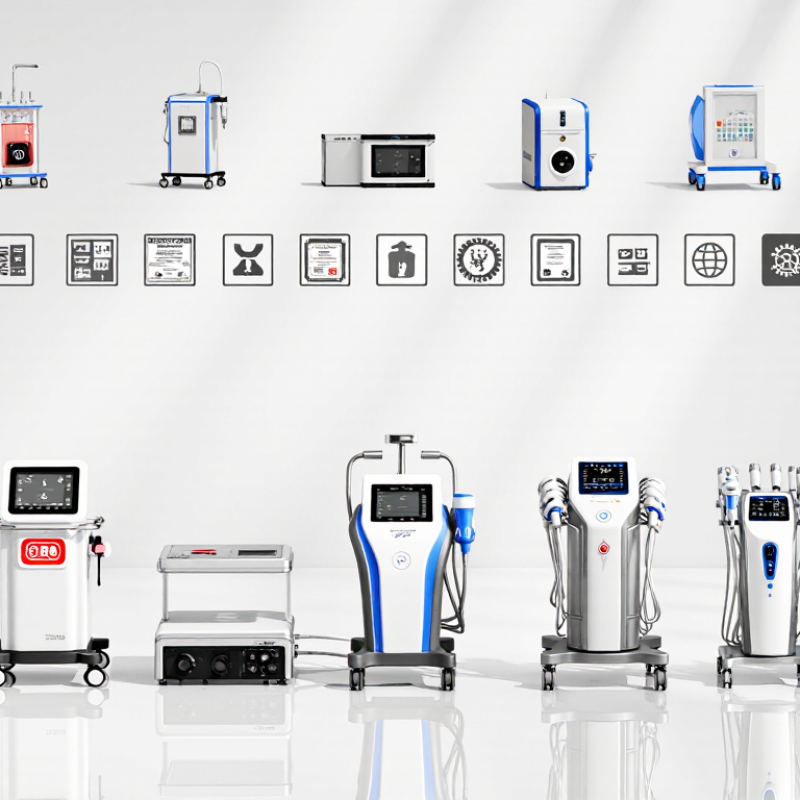
A leading Chinese skin esthetician equipment manufacturer is defined by evidence, not a glossy catalog. Grand View Research estimated the global medical aesthetics market at approximately USD 17 billion in 2023, with strong growth expected through 2030. That expansion raises the value of reliable engineering and measurable treatment performance. Experienced manufacturers document energy output, cooling stability, handpiece durability, and maintenance intervals. They also test equipment across different skin tones and operating environments. Not merely a catalog.
Professional credibility appears in quality systems. ISO 13485 certification supports controlled medical-device production, while ISO 14971 encourages structured risk management. Where applicable, IEC 60601-1 testing strengthens electrical safety claims. Chinese manufacturers serving international markets should also explain relevant NMPA, CE, or other market requirements clearly.
Vague certificates deserve questions. A useful supplier provides calibration records, serial-number traceability, user training, and responsive technical support. According to Fortune Business Insights, the global medical aesthetics market was valued at about USD 18.53 billion in 2023, showing why after-sales capability matters as installations increase.
Yet no factory is flawless. I would still request sample test reports, failure-rate data, and customer references before judging production capacity. Evidence matters more.
China’s Top 10 Skin Esthetician Equipment Manufacturers
China’s leading skin esthetician equipment manufacturers now serve clinics, salons, and home-care channels worldwide. Grand View Research reported that the global medical aesthetics market exceeded USD 17 billion in 2023. This growth increases demand for safer, more precise facial devices. The top ten manufacturers should not be judged by export volume alone. A stronger review examines product testing, manufacturing consistency, after-sales training, and regulatory documentation.
Professional buyers should check ISO 13485 quality systems and applicable IEC 60601 safety requirements. They should also request test reports, user instructions, and maintenance records. The International Trade Centre shows China remains a major exporter of electrical and electronic equipment. However, export strength does not always prove clinical reliability. A ranking is never perfectly neutral. Factory audits and independent demonstrations still matter.
Tips: Compare energy output, cooling control, handpiece weight, and treatment workflow. Ask for evidence from real clinics, not only polished brochures. Confirm whether the supplier supports calibration and staff training. Market reports from Fortune Business Insights indicate continued expansion in aesthetic device demand, yet forecasts can change quickly. Therefore, buyers should treat market size as context, not proof of performance. One overlooked detail is consumable availability. Without stable accessories, even a well-designed device may become difficult to operate.
Core Technologies Used in Professional Skin Esthetician Equipment
When comparing China’s top 10 skin esthetician equipment manufacturers, buyers should examine core technologies, not polished casings. Professional devices combine controlled energy, contact monitoring, and treatment feedback. Radiofrequency uses alternating current to warm deeper tissue gradually. A trained operator watches temperature, timing, and client comfort. Results vary. They are not guaranteed.
LED systems use selected wavelengths for non-invasive light treatments. Output stability matters more than colorful displays. Professional designs may include optical sensors, cooling channels, and automatic power adjustment. Ultrasound handpieces create mechanical vibrations and can support product application. Microcurrent devices deliver low-level electrical stimulation through conductive surfaces. These systems need clear parameters and consistent electrode contact. Small gaps can make treatment uneven.
Reliable manufacturers document testing, electrical protection, cleaning methods, and calibration intervals. Look for readable manuals, service records, and replaceable contact parts. In a clinic, a device should reduce output when contact is lost. That detail protects both workflow and skin. I would also test noise, handpiece weight, and setup time. They affect daily results. One weakness remains: marketing often describes “deep” action without explaining measurement methods. Ask for clinical evidence, verified specifications, and operator training before purchase.
How to Compare Chinese Manufacturers and Their Product Quality
Comparing China’s top skin esthetician equipment manufacturers requires more than checking prices or factory photographs. Grand View Research estimates that the global medical aesthetics market could grow at about 12% annually through 2030. That growth attracts capable factories and inexperienced suppliers. A polished showroom proves little. Ask for production records, calibration logs, batch traceability, and independent safety testing.
Quality becomes visible during verification. Request a working sample and test its temperature stability, treatment output, noise, and emergency shutdown. For electrical devices, check evidence related to IEC 60601-1 and electromagnetic compatibility, where applicable. ISO 13485 certification may indicate a controlled quality system, but it does not guarantee every product is reliable. Inspect the certificate scope and issuing body. Do not accept vague “CE approved” claims without supporting documents.
Small details matter. Examine cable strain relief, handpiece seals, cooling performance, and replacement-part availability. Ask how complaints are recorded and resolved. A manufacturer offering only a long warranty may still provide weak after-sales service. The China Association of Medical Devices Industry has repeatedly emphasized stronger quality management and traceability across medical-device production. That is encouraging, but supplier claims still require verification. My own comparison method would include at least three samples, not one. One sample can look perfect by accident. Test results can also change between production batches.
Key Factors for Selecting the Right Equipment Manufacturer
Selecting among China’s top 10 skin esthetician equipment manufacturers requires more than comparing factory prices. The ISAPS International Survey on Aesthetic/Cosmetic Procedures 2023 recorded over 34 million surgical and nonsurgical procedures worldwide. This growing demand makes device reliability, treatment consistency, and technical support essential purchasing criteria.
Ask each manufacturer for complete specifications, test reports, and traceable quality records. ISO 13485 certification can indicate a structured medical-device quality system, but certification alone proves little about daily performance. Request sample units when possible. Check handpiece temperature, energy stability, noise, cleaning access, and software usability during a real treatment simulation. Small details matter.
After-sales service deserves equal attention. Confirm spare-part availability, remote troubleshooting, technician response times, and operator training. Grand View Research reported strong expansion in the global medical aesthetics market, with double-digit annual growth projected through 2030. Rapid growth can encourage rushed product launches. Be careful.
A clear warranty is useful. A vague warranty is not. Manufacturers should also explain electrical safety, contraindications, maintenance intervals, and local compliance requirements. Avoid choosing solely by catalog appearance or the lowest quotation. That approach may save money initially, yet downtime and retraining can cost more. No evaluation scorecard is perfect; independent clinical feedback and documented field performance should influence the final decision.
| No. | Selection Factor | Suggested Weight | What Should Be Verified | Recommended Buyer Checkpoint | Main Risk If Overlooked |
|---|---|---|---|---|---|
| 1 | Regulatory and Product Compliance | 18% | Confirm whether the equipment is classified as a cosmetic, wellness, or medical device in the destination market. Check applicable conformity documents, product labeling, technical files, and declarations of conformity. | Request model-specific documentation rather than generic certificates. For electrical equipment, verify relevant safety and electromagnetic-compatibility test reports. | Customs delays, sales restrictions, product recalls, or legal liability. |
| 2 | Quality Management System | 14% | Review the manufacturer’s quality-management certification, document-control process, incoming inspection, final inspection, nonconformity handling, and corrective-action procedures. | Verify that the certificate scope covers the relevant product category and manufacturing site. Ask for recent audit or quality-performance records where available. | Inconsistent product quality, repeated defects, and weak traceability. |
| 3 | Safety Engineering and Risk Control | 13% | Check electrical insulation, grounding, overheating protection, emergency-stop functions, leakage-current testing, optical or energy-output controls, and user warnings. | Ask for a product risk assessment, safety test reports, preventive-maintenance requirements, and documented operating limits. | Burns, eye injuries, electrical shock, skin damage, or unsafe operation. |
| 4 | Product Performance and Treatment Consistency | 12% | Evaluate output stability, treatment parameters, temperature or energy consistency, handpiece performance, software accuracy, and repeatability between units. | Conduct sample testing using predefined acceptance criteria. Compare measured output with the specifications stated in the technical documentation. | Uneven treatment results, customer dissatisfaction, and higher warranty claims. |
| 5 | Manufacturing Capacity and Process Control | 10% | Review production lines, assembly procedures, calibration equipment, supplier controls, batch records, capacity planning, and inspection checkpoints. | Request a factory audit or live video audit. Confirm whether production is performed in-house or outsourced and identify critical process suppliers. | Delivery delays, unannounced component substitutions, and variable production quality. |
| 6 | Research, Development, and Customization Capability | 9% | Assess engineering resources, firmware and software control, industrial design, electrical engineering, testing capability, and experience with customized specifications. | Define the customization scope in writing, including enclosure design, user interface, operating language, electrical configuration, accessories, and ownership of technical files. | Delayed projects, unstable modifications, and limited ability to adapt products to local requirements. |
| 7 | After-Sales Service and Technical Support | 9% | Verify warranty duration, response times, troubleshooting procedures, remote support, service manuals, spare-parts availability, and technician training. | Include service-level requirements in the purchase agreement. Confirm the process for repairs, replacement parts, software updates, and escalation of safety issues. | Long downtime, expensive repairs, and poor end-user experience. |
| 8 | Supply-Chain Reliability and Lead Time | 6% | Examine component sourcing, critical-part availability, standard production lead time, order capacity, packaging controls, and business-continuity planning. | Obtain written lead-time commitments and identify alternative components that are approved for use. Confirm how shortages or engineering changes will be communicated. | Stockouts, missed launch dates, and unexpected changes in product specifications. |
| 9 | Total Cost of Ownership | 5% | Compare unit price with tooling, certifications, shipping, installation, training, consumables, maintenance, replacement handpieces, software, and warranty costs. | Request a three-year cost estimate and clarify which accessories, consumables, calibration services, and replacement parts are included. | A low purchase price may result in higher operating and maintenance costs. |
| 10 | Business Transparency and Reference Verification | 4% | Check legal business details, manufacturing address, export experience, contract terms, payment controls, customer references, complaint history, and consistency between documents and actual facilities. | Use independent verification where possible, validate references in comparable markets, and avoid making a final decision based only on online listings or product photographs. | Misrepresentation, contractual disputes, payment loss, or difficulty obtaining support. |
Related Posts
-
2026 Top Facial Salon Equipment Suppliers?
-
Best Face Spa Manufacturers in China for Global Buyers
-
What Is a Facial Salon and How Does It Work?
-

Revitalize Your Skin with the Ultimate Face Spa Techniques for Glowing Results
-

Unlock Radiant Skin: How Esthetician Facial Machines Transform Your Beauty Routine
-

Top 10 Facial Esthetician Techniques for Glowing Skin