
Skip to content
Policy FAQ
   
(908) 210-9335
   
Now Available: Cherry Payment Plans!
Are you interested in paying in installments with Cherry payment plans? Get pre-approved today! Applying won’t harm your credit!
graphical user interface, website

Top 10 Facial Bar Manufacturers for Global Buyers?

Facial bar demand is rising as buyers seek compact, water-saving, and plastic-conscious cleansing formats. The opportunity looks simple. It is not.

Grand View Research’s global soap market report identifies continued growth in personal cleansing, supported by premium formulations and sustainability claims. Euromonitor International’s 2024 beauty and personal care analysis also highlights solid formats, ingredient transparency, and skin-barrier protection as important consumer priorities. However, dedicated facial bar data remains limited. Many reports group facial bars with hand soap, body soap, or syndet cleansers. This creates a measurement problem.

Formulation matters most. Dermatologist Dr. Joshua Zeichner has warned, “Bar soaps can be harsh on the skin, stripping it of essential oils.” His comment is especially relevant for global buyers comparing traditional soap with low-pH syndet facial bar products. Buyers should inspect surfactant systems, pH values, fragrance levels, moisture-barrier claims, testing documents, and packaging performance. A smooth bar should not leave the face tight, squeaky, or visibly flaky.

Real sourcing also depends on factory experience. Can the manufacturer maintain weight consistency across batches? Can it control cracking during humid shipping? Can it provide stability, microbial, allergen, and safety documentation? These details often matter more than attractive photographs.

The ranking in this guide evaluates the top 10 facial bar manufacturers for global buyers through product quality, manufacturing capability, customization, certifications, export experience, and communication reliability. It is not a perfect list. Supplier data changes, and some companies disclose less than buyers need. Careful verification remains essential.
Top 10 Facial Bar Manufacturers for Global Buyers?

What Are Facial Bars and Why Are They Popular Worldwide?

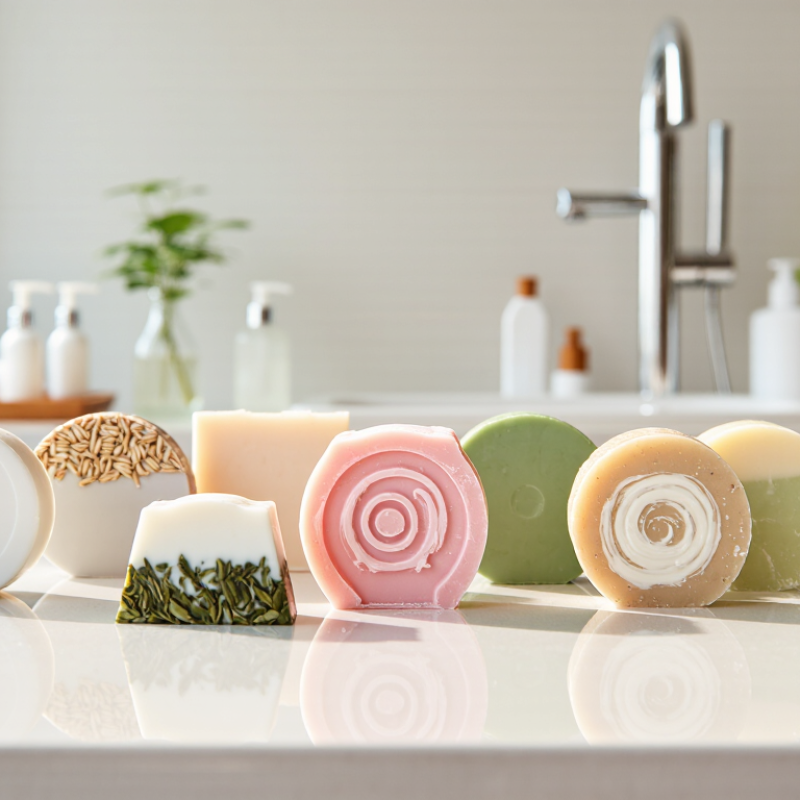
Facial bars are solid cleansers made specifically for facial skin. They may use mild syndet ingredients or traditional soap bases. Unlike body soap, a well-designed facial bar should support comfortable cleansing without leaving tightness. Formulation details matter, including pH, fragrance levels, surfactant selection, and moisture control.

Their worldwide popularity comes from convenience. A facial bar fits easily into a travel pouch, lasts through many washes, and needs little packaging. It also avoids liquid restrictions during air travel. Many buyers appreciate its compact form and simpler storage. However, a facial bar is not automatically more sustainable. Its impact depends on ingredients, wrapping materials, production energy, and transport distance. This is where careful sourcing becomes important. The category still needs improvement.

Tips: Global buyers should request ingredient specifications, safety assessments, stability data, and batch traceability. Ask how the manufacturer controls moisture and prevents cracking during shipping. Check whether product claims match reliable testing. Sensitive-skin users may prefer fragrance-free formulas, while dry skin often needs gentler cleansing agents and added emollients. A sample trial is essential. Skin can react differently, even when a formula looks impressive on paper.

Suppliers should also provide clear labeling and consistent quality records. Experienced manufacturers usually explain testing limits instead of promising universal results. That honesty matters. Claims such as “natural,” “clean,” or “eco-friendly” should be verified, not accepted as proof. A facial bar can be practical, elegant, and efficient, but only when its formulation and supply chain receive equal attention.

Facial Bars for Global Buyers: Typical pH Ranges

Facial bars are solid cleansing products designed to remove excess oil, sunscreen, makeup, and impurities from the face. Their popularity is supported by compact packaging, lower water content, convenient shipping, and growing interest in low-waste personal-care formats. For buyers, pH is an important formulation and skin-compatibility consideration.

The chart compares commonly reported or specified pH ranges. Healthy facial skin is generally mildly acidic, while traditional soap is typically alkaline. Syndet and soap-free facial bars can be formulated closer to the skin’s natural acid mantle. Actual values vary according to ingredients, water content, testing method, and product formulation.

Sources: Lambers H. et al., “Natural skin surface pH is on average below 5,” International Journal of Cosmetic Science, 2006; Gehring W., “The influence of pH on the skin,” Current Problems in Dermatology, 2006; product-formulation literature on soap and syndet cleansers.

How to Evaluate Facial Bar Manufacturers for International Sourcing

Top 10 Facial Bar Manufacturers for Global Buyers?

How to Evaluate Facial Bar Manufacturers for International Sourcing

Global facial care demand is expanding. Grand View Research valued the skincare products market at USD 155.7 billion in 2022, with a projected 4.7% CAGR through 2030. However, this figure covers skincare broadly, not facial bars alone. Buyers should therefore avoid accepting market size as proof of product demand. Request regional sales data, repeat-order records, and clear consumer feedback from each manufacturer.

Start with factory evidence, not attractive catalogs. Check ISO 22716-based good manufacturing practices, batch traceability, microbial testing, stability results, and ingredient documentation. Ask for a sample batch and compare its color, scent, hardness, lather, and skin feel after storage. A polished factory tour can still mislead. Confirm audit dates, testing laboratories, corrective actions, and production capacity in writing. One overlooked detail is water activity, which can affect bar stability and contamination risk.

Packaging also deserves measurable scrutiny. The OECD’s Global Plastics Outlook reported that only 9% of plastic waste was recycled globally in 2019. Facial bars may reduce liquid packaging, but paper, coatings, adhesives, and shipping materials still require verification. Ask for packaging composition, recyclability evidence, carton-drop tests, and export documentation. Compare minimum order quantities, lead times, payment terms, and defect policies. The cheapest quote is often incomplete. I would also challenge unrealistic claims, including “chemical-free” language, because every cosmetic formula contains chemicals. A reliable supplier welcomes questions, shares controlled records, and admits limitations. That last point matters.

Top 10 Facial Bar Manufacturers Serving Global Buyers

Global buyers need more than attractive facial bars and low quotations. The top 10 manufacturers serving international markets are usually distinguished by reliable production, clear documentation, and flexible private-label support. A strong shortlist includes facilities with certified cosmetic systems, low-minimum-order specialists, sensitive-skin formulators, botanical bar producers, fragrance-free manufacturers, export-focused factories, sustainable packaging teams, high-volume plants, custom-mold workshops, and testing-led laboratories.

Each manufacturer should show ingredient specifications, batch records, stability results, and microbial testing procedures. Buyers should also check whether the facility follows recognized cosmetic manufacturing practices. Export experience matters. A supplier may produce excellent bars but struggle with customs documents, carton markings, or temperature-sensitive storage. Small details often delay a shipment.

Ask for pilot samples before approving a large order. Check the bar after repeated use, not only on the first wash. Observe lather, hardness, scent retention, and skin feel. Packaging should survive humid warehouses and long-distance transport. No factory is perfect. A polished catalog can hide weak communication or inconsistent batches. Buyers should compare response times, corrective-action records, and testing transparency. Pricing deserves attention, but it should never replace evidence. A dependable manufacturer explains limitations clearly, accepts reasonable audits, and updates documentation when formulas or packaging change. That practical discipline separates a promising supplier from a truly global partner.

Which Manufacturing Standards and Certifications Matter Most?

Global buyers evaluating facial bar manufacturers should examine standards before comparing price, packaging, or production capacity. A polished factory tour means little without documented controls. ISO 22716 supports good manufacturing practices for cosmetics, including hygiene, staff training, equipment cleaning, and batch records. ISO 9001 can strengthen quality management, but it does not prove a bar is safe for every market. Ask for current certificates, issuing bodies, scope, expiry dates, and the exact manufacturing site. Ask for evidence.

A reliable supplier should provide ingredient specifications, INCI names, allergen information where applicable, and a certificate of analysis for each batch. Testing should cover appearance, odor, pH, moisture, microbial limits, and stability under realistic storage conditions. For syndet or botanical bars, request compatibility data for sensitive-skin claims. Claims need proof. Do not accept “natural” or “hypoallergenic” as technical evidence without supporting evaluation. Traceability is equally important. One coded batch should connect raw materials, operators, test results, and shipment records.

Independent audits can reveal details that certificates miss, such as wet floors near production areas or poorly sealed retain samples. In practice, documentation can look complete while change-control records remain vague. That gap deserves questions, not automatic rejection. A capable manufacturer explains deviations, corrective actions, and recall procedures clearly. Certification logos can be copied or outdated, so verify them directly with the issuing body when possible. A small pilot order, retained samples, and a pre-shipment review may expose weaknesses earlier than a large contract.

How to Select the Right Facial Bar Supplier for Your Market

How to Select the Right Facial Bar Supplier for Your Market

Global buyers need more than a low quotation. Grand View Research valued the global soap market at approximately USD 45.38 billion in 2023, with continued growth expected through 2030. This expansion attracts capable factories and inexperienced traders. A supplier should show production experience with facial bars, not only body soap. Request recent batch records, ingredient specifications, microbial test results, and stability data. Samples should be tested after transport, heat exposure, and repeated use.

Check manufacturing controls against ISO 22716 cosmetic good manufacturing practices. Confirm whether the factory controls pH, moisture, fragrance dosage, curing time, and packaging quality. These details affect facial comfort and shelf life. The Personal Care Products Council reports that consumers increasingly expect ingredient transparency and product safety. Your supplier should therefore provide clear INCI lists, allergen information, and traceable raw-material documents. Do not accept vague claims.

Market fit matters. A hard bar may suit humid shipping routes, but it can feel tight on dry skin. Fragrance preferences also vary sharply by region. Ask for pilot batches with different cleansing strengths and package formats. I have learned that a polished sample can still hide weak consistency. That assumption fails. Compare at least three production batches, inspect factory records, and measure defect rates before signing. Price is only one variable. Reliable communication, realistic minimum orders, ethical sourcing, and responsive corrective action often determine whether a launch survives its first year.

Back To Top Skip to content